

The Proliferation of Form
After the realization of our first wooden sets, our obsession with "correct geometry" only deepened. We didn't stop at a single object. Inspired by the way children interact with raw materials, we spent 2015 developing dozens of new systems — from complex construction blocks to modular puzzles. This era was defined by a singular goal: to create a library of forms that challenge the mind while soothing the interior space.
Lucky Toys: A Systemic Approach
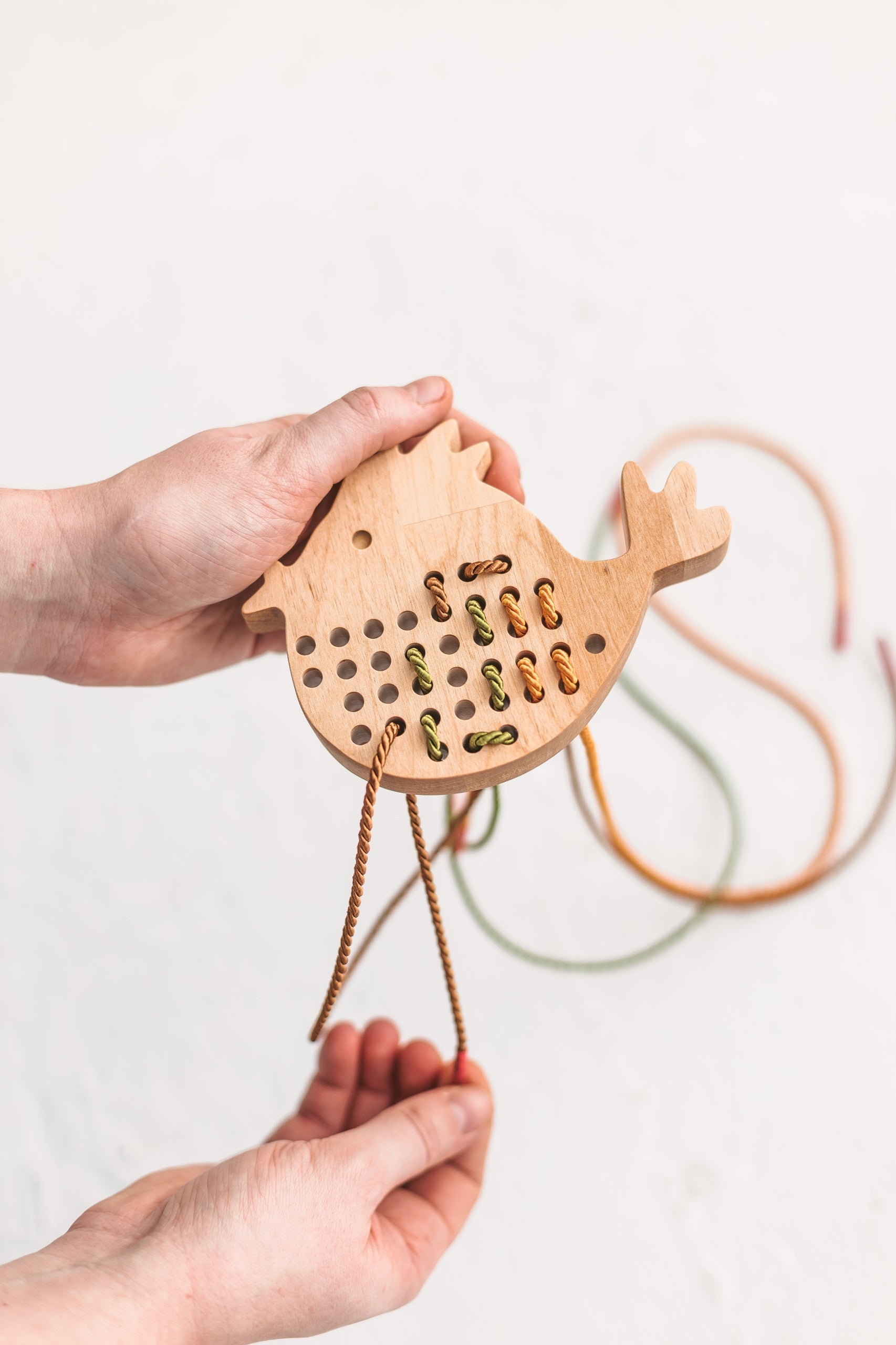
Among our numerous projects, Lucky Toys became the most significant manifestation of our early philosophy. It wasn't just a toy; it was a multi-functional tool for development. We moved beyond simple stacking to explore lacing, pattern creation, and even jewelry-making. Using European beechwood, natural cotton, and juniper beads, we created a tactile language that allowed children to explore motility and balance simultaneously.

The Architect’s Point of View
Whether it was a bear-shaped lacing board or a 15-piece geometric set, we treated every project as a piece of architectural engineering. We avoided "plastic noise" and lurid colors, focusing on the honest patina of sanded wood. These archives serve as a bridge to our current work: the same dedication to quality, the same elimination of the redundant, and the same belief that functional objects should be beautiful enough to serve as standalone sculptures.
Object Archive: Lucky Toys Series
What was Lucky Toys? Lucky Toys was a study in multi-functional modularity and tactile education. The Series was defined by the smooth surface of European beech and natural fibers. The System was designed to transform from a developmental tool into a decorative object. The Collection was engineered to engage fine motor skills, logic, and creative weaving.

Lucky Toys could:
-
Develop motility through intricate lacing and sewing sequences;
-
Encourage creative jewelry-making and pattern creation;
-
Serve as a minimalist pencil holder or a desktop sculptural piece;
-
Function as wall decor, bringing organic textures to a room;
-
Engage the imagination by transforming a flat form into a 3D architectural study.
Technical Archive: Material: European Beechwood / Natural Cotton / Juniper Beads Finish: Raw sanded surface (chemical-free) Components: Lacing boards, cords, and geometric blocks Functions: Motility, Weaving, Drawing, Wall Decor Origin: Developed and scaled in 2015 Status: Archived / Historical Collection



Share:
Archive 01: The Geometry of Play (2015)
Archive 03: Scaling the Texture (2016–2019)