

When Function Becomes Beauty
In the world of industrial design, very few objects achieve true timelessness. The Anglepoise lamp is one of them. Instantly recognizable, endlessly functional, and mechanically elegant, it represents a rare moment where engineering is not hidden—but celebrated.
More than just a desk lamp, Anglepoise is a masterclass in how pure function can evolve into visual identity.
The Origin: A Problem Solved with Precision
The story of Anglepoise begins in the 1930s with automotive engineer George Carwardine. While working on vehicle suspension systems, he developed a unique spring mechanism capable of maintaining perfect balance.
Instead of applying it only to cars, he saw a new opportunity: a lamp that could move freely and stay exactly where you put it.
This idea led to the creation of the first Anglepoise lamp—an object defined by:
-
Mechanical precision
-
Dynamic movement
-
Perfect balance
It wasn’t designed to be beautiful. It was designed to work flawlessly—and that’s exactly why it became beautiful.

The Core Innovation: The Spring Mechanism
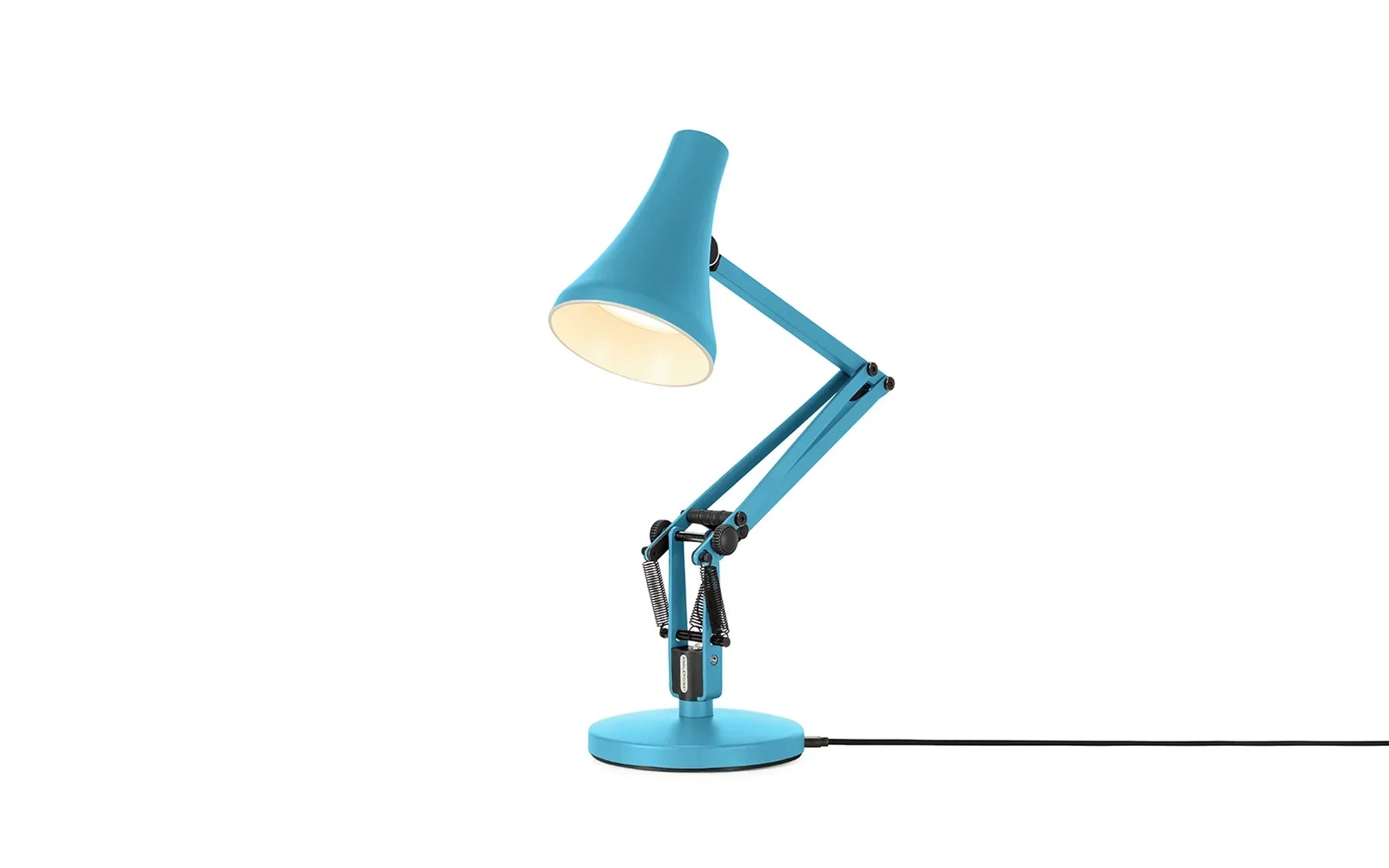
At the heart of the Anglepoise lamp lies its defining feature: a constant-tension spring system.
Unlike traditional lamps that rely on friction or fixed joints, Anglepoise uses springs to create equilibrium. This allows the lamp to:
-
Move smoothly in multiple directions
-
Hold any position without slipping
-
Maintain stability regardless of angle
This mechanism turns the lamp into something more than a static object—it becomes an interactive tool.
From a design perspective, the springs and joints are not hidden. They are fully visible, forming the lamp’s visual identity.
This is where Anglepoise becomes revolutionary:
the engineering is the design.
Form Follows Function—Perfectly
Anglepoise is one of the purest examples of the modernist principle “form follows function.”
Every part of the lamp exists for a reason:
-
The arms → provide reach and flexibility
-
The springs → ensure balance
-
The base → stabilizes the structure
-
The shade → directs light precisely
There are no unnecessary elements, no decorative additions. And yet, the result is iconic and instantly recognizable.
This is the paradox of great design:
when nothing extra is added, the object becomes unforgettable.

A Symbol of Creative Workspaces
Over the decades, the Anglepoise lamp has become deeply associated with creative environments.
It is commonly found in:
-
Design studios
-
Architecture offices
-
Art workspaces
-
Home desks of creatives
Why? Because it represents the same values that creatives rely on:
-
Precision
-
Flexibility
-
Focus
The lamp doesn’t just illuminate a workspace—it defines it.
Cultural Impact: From Workbench to Pixar
One of the most famous cultural references to Anglepoise is its influence on the animated lamp in Pixar.
The iconic hopping desk lamp seen in Pixar’s logo is directly inspired by the Anglepoise design. It captures:
-
The articulated movement
-
The expressive flexibility
-
The personality hidden within mechanical form
This moment transformed the lamp from an industrial object into a cultural symbol.
It proved that even a purely functional design can evoke emotion and character.

Why Anglepoise Still Matters Today
In today’s world of sleek, minimal, often anonymous products, Anglepoise remains relevant because it offers something different:
1. Honesty in Design
Nothing is hidden. The mechanism is visible and understandable.
2. Timeless Functionality
The core idea still works perfectly nearly a century later.
3. Emotional Connection
Despite being mechanical, the lamp feels alive through its movement.
4. Recognizable Identity
Few products can be identified by silhouette alone—Anglepoise can.
Engineering as Aesthetic: A Design Philosophy
The Anglepoise lamp represents a powerful idea that extends far beyond lighting:
Good engineering doesn’t need decoration. It becomes decoration.
This philosophy can be seen in many modern design movements, including:
-
Industrial minimalism
-
Transparent product design (like Nothing devices)
-
Functional architecture
Anglepoise was one of the earliest and clearest expressions of this mindset.
Lessons for Designers and Brands
For anyone building products or brands today, Anglepoise offers valuable lessons:
-
Focus on one strong idea, not many features
-
Let function define form
-
Make the product visually understandable
-
Create something that people can interact with naturally
In a market saturated with complexity, simplicity combined with clarity becomes a competitive advantage.
Conclusion: A Lamp That Became a Legacy
The Anglepoise lamp is more than a piece of lighting—it is a design philosophy embodied in an object.
It shows that when engineering is executed with clarity and purpose, it can transcend utility and become:
-
A cultural icon
-
A workspace essential
-
A symbol of creative thinking
Ultimately, Anglepoise proves that true design innovation doesn’t come from adding more—but from refining what already works to perfection.




Share:
Fatboy x Dutch Design: How Playfulness Became a Modern Design Philosophy
Juicy Salif by Philippe Starck: Iconic Design Beyond Function