

I didn’t notice it at first.
That sounds strange, considering it’s a lamp—but that’s exactly how it began. I was sitting at a long table, somewhere between working and not working, and the light above me didn’t demand attention. It just… existed. Quietly. Precisely.
Only later did I realize I had been looking better, thinking clearer.
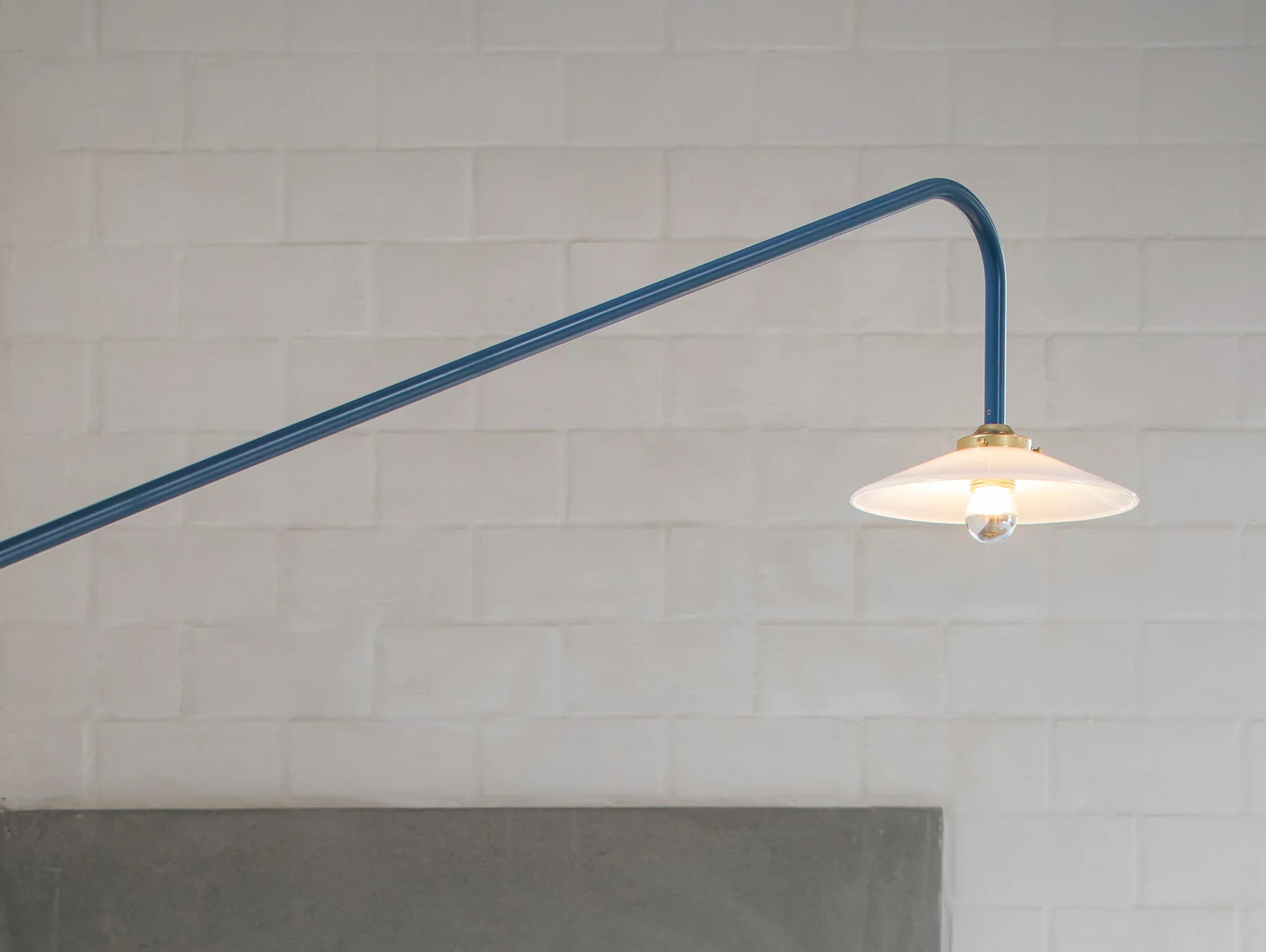
That was my first encounter with the Valerie Objects Hanging Lamp No.1.

I came across Valerie Objects through a rabbit hole of understated design—objects that don’t scream “design,” but quietly reshape how you experience a space. This one, created by Muller Van Severen, felt almost too simple to matter.
A thin line. Suspended.
That’s it.
At least, that’s what it looks like.
When I installed it, I made a mistake.
I hung it too high.
And for a few days, I couldn’t understand why it felt… distant. The light was technically there, but it didn’t touch anything. The table remained visually disconnected, like it wasn’t part of the same conversation.
So I lowered it.
Not dramatically—just enough so that the lamp began to define the space rather than float above it.
That’s when it clicked.
This lamp isn’t about illumination. It’s about positioning.
Living with it changed how I think about light entirely.
Most hanging lamps are objects first, light sources second. They have shades, volumes, presence. They decorate as much as they illuminate.
This one removes almost all of that.
What remains is a kind of drawn line in space—a gesture more than an object.
And because of that, every small decision matters.
The height. The length. The exact placement above a table or surface. A few centimeters too high or too low, and the entire feeling shifts.
I started noticing how the light spreads—not diffusely, but directionally. It creates a soft but focused pool, almost like a quiet stage. The edges fade gently, without harsh contrast, but there’s still a sense of boundary.
It doesn’t flood the room.
It edits it.

There’s something else I didn’t expect.
The color of the structure—often overlooked in photos—plays a much bigger role in real life. Depending on the finish, the lamp can either disappear into the ceiling or become a subtle line of color cutting through the air.
I chose a version that slightly contrasts with my ceiling, and it changed the entire reading of the space. Not loudly. But enough that your eye registers it subconsciously.
It’s not decoration.
It’s punctuation.
From a materials perspective, it’s almost brutally honest.
No unnecessary layers. No attempt to soften its construction. The tube, the cable, the connections—they’re all visible if you look closely. And that visibility is intentional.
In a world where lighting often tries to hide how it works, this one does the opposite.
It shows just enough.
And that creates a strange kind of trust. You understand the object immediately, but you don’t fully understand its effect until you live with it.
Compared to more traditional pendant lights—even high-end ones—this feels like a different philosophy entirely.
There’s no central “body,” no sculptural mass. It doesn’t anchor itself through volume. Instead, it relies on proportion and tension.
Most lamps fill space.
This one defines it.
But it’s not without its challenges.
First, it’s unforgiving.
If your ceiling height is awkward, or your table placement isn’t intentional, the lamp will expose it. It doesn’t adapt to the room—you adapt the room to it.
Second, it’s not a “one-lamp solution.”
You won’t rely on it to light an entire room. It works best in combination with other light sources—ambient, indirect, softer layers. Think of it as a precise tool rather than a general one.
And then there’s the psychological aspect.
Some people don’t feel comfortable under it at first. It lacks the visual softness of traditional lampshades, so it can feel slightly… exposed. Like sitting under a line rather than inside a glow.
That feeling fades, but it’s real.
What surprised me most, though, is how it changed my behavior.
I started organizing my table differently. Keeping it clearer. More intentional. Because the light emphasizes what’s directly beneath it, clutter becomes more visible—not in a harsh way, but in a quietly revealing one.
It made me edit my space.
Not because I had to—but because I wanted to.
Over time, the lamp became less of an object and more of a habit.
I don’t think about it anymore, but I notice when it’s not there. When I sit under other lights, I feel the difference immediately. Either too much diffusion, or too much presence, or just… noise.
This one is silent.
And that silence is rare.
There’s also something people don’t often talk about.
The way this lamp photographs versus how it feels in real life are two completely different things.
In photos, it can look almost too minimal—like it’s missing something. But in reality, that absence is exactly what gives it power. It leaves space for everything else to exist more clearly.
It doesn’t compete.
It clarifies.
So who is this for?
Not for someone looking for a statement piece in the traditional sense. Not for someone who wants instant visual gratification.
It’s for people who notice small shifts. Who care about how light shapes behavior, not just how it looks.
People who understand that design isn’t always about adding—but sometimes about removing.
Would I recommend it?
Yes—but only if you’re willing to engage with it.
This isn’t a passive object. It asks for decisions. It asks for attention. And in return, it gives you something subtle but lasting.
A different way of seeing your own space.


Share:
Personal Story of the De Sede DS-1025 Terrazza Sofa
8 Favorites from the New IKEA PS 2026 Collection