

I didn’t sit on it the first time I saw it.
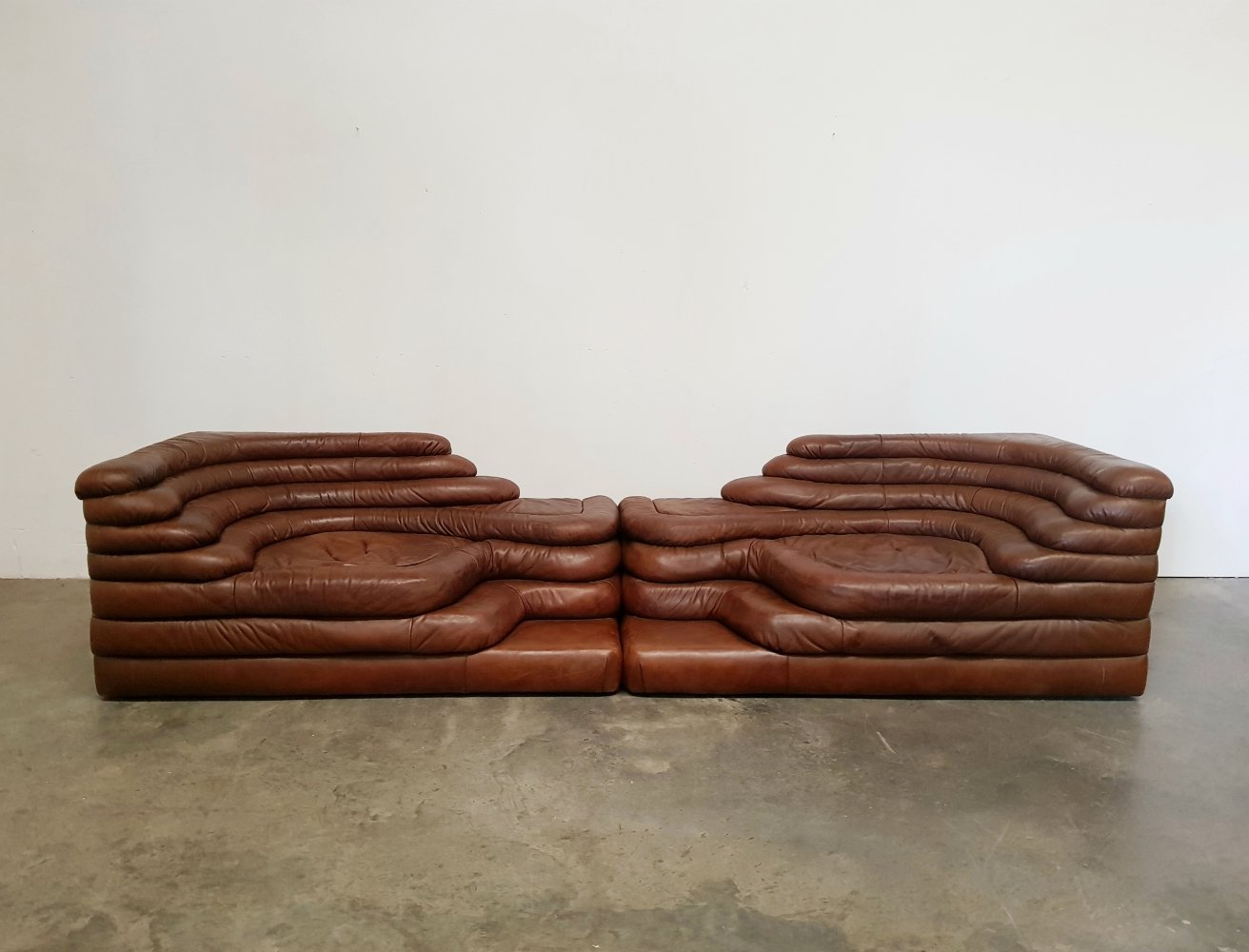
That’s what I remember most clearly. Not comfort, not price, not even the shape—but hesitation. The De Sede DS-1025 Terrazza Sofa looked less like furniture and more like a landscape that had somehow wandered indoors. A piece of terrain, almost. Something you observe before you use.
It felt wrong to just… sit.
I encountered it in a quiet showroom, the kind where every object feels slightly over-aware of itself. In the middle of the space, there it was—low, stepped, almost geological.
Designed by Ubald Klug in the 1970s, it carries that strange energy of that era—when design stopped behaving and started experimenting. And this piece really doesn’t behave.
It doesn’t give you a clear place to sit. It asks you to decide.

The first time I finally lowered myself onto it, I didn’t sit upright.
I leaned.
The surface isn’t flat. It rises and falls in soft leather steps, like terraces carved into a hillside. You don’t “take a seat”—you find a position. It’s subtle, but it changes everything. Sitting becomes less formal, less structured. Almost accidental.
And the leather… it’s not just soft. It has that lived-in tension, even when new. Slight wrinkles, slight resistance. The kind of material that doesn’t hide its nature. It reminds you that this piece was built, not just assembled.
Over time, I realized something: this sofa isn’t about symmetry or balance.
Each module—left, right—feels like part of a larger topography. The widths and depths shift in a way that feels irregular but intentional, like terraces in vineyards or hills shaped over time.
You can arrange it, expand it, build something entirely your own. A two-seater. A strange pyramid. A kind of soft sculpture that people can inhabit.
Most sofas tell you where to sit.
This one asks, “Where do you want to exist?”

From a design perspective, it’s almost rebellious.
The structure underneath—beechwood, layered upholstery, dense padding—keeps it grounded, but visually it floats somewhere between object and environment.
Compared to conventional sofas, even high-end ones, there’s usually a clear hierarchy: seat, backrest, armrest. Here, that hierarchy dissolves.
There is no “correct” position.
And that’s where it becomes interesting—and maybe a little uncomfortable.
Because let’s be honest: it’s not the most practical sofa.
If you’re looking for something to collapse into after a long day, something predictable and ergonomic, this might frustrate you. The stepped surface means you’re always slightly adjusting, always aware of your posture.
And not everyone gets it.
I’ve had people walk into the room, glance at it, and laugh—not in a dismissive way, but in confusion. Some call it brilliant. Others… not so much. Even when it first came out, critics were divided—some loved its boldness, others called it excessive.
It’s one of those objects that reveals your taste, whether you want it to or not.
But here’s the strange part.
After living with it for a while, I stopped questioning it.
It stopped being “the sofa” and became part of how the space felt. The way light settles on the leather ridges. The way shadows form between the steps. The way it quietly changes how people sit, how they move, how they interact.
Conversations feel different around it.
Less formal. Less staged.
People shift positions, lean sideways, sit diagonally. It breaks the invisible rules of how a living room is supposed to function.

And maybe that’s what I’ve come to appreciate most.
The De Sede DS-1025 Terrazza Sofa doesn’t try to be comfortable in the conventional sense. It tries to be something else entirely.
An experience.
A presence.
Something that sits between art and utility without fully committing to either.
Would I recommend it?
Not easily.
This isn’t a sofa for everyone. It’s not even a sofa for most people.
It’s for those who are willing to live with a question instead of an answer. For people who don’t mind that a piece of furniture might challenge them, slightly, every day.
For those who see their space not just as a place to relax—but as something to think about.
And if that sounds like you, then yes.
Sit on it.
Or don’t.
It doesn’t really care either way.


Share:
A Quiet Object That Changed My Space
The Lamp That Made Me Rethink Light