

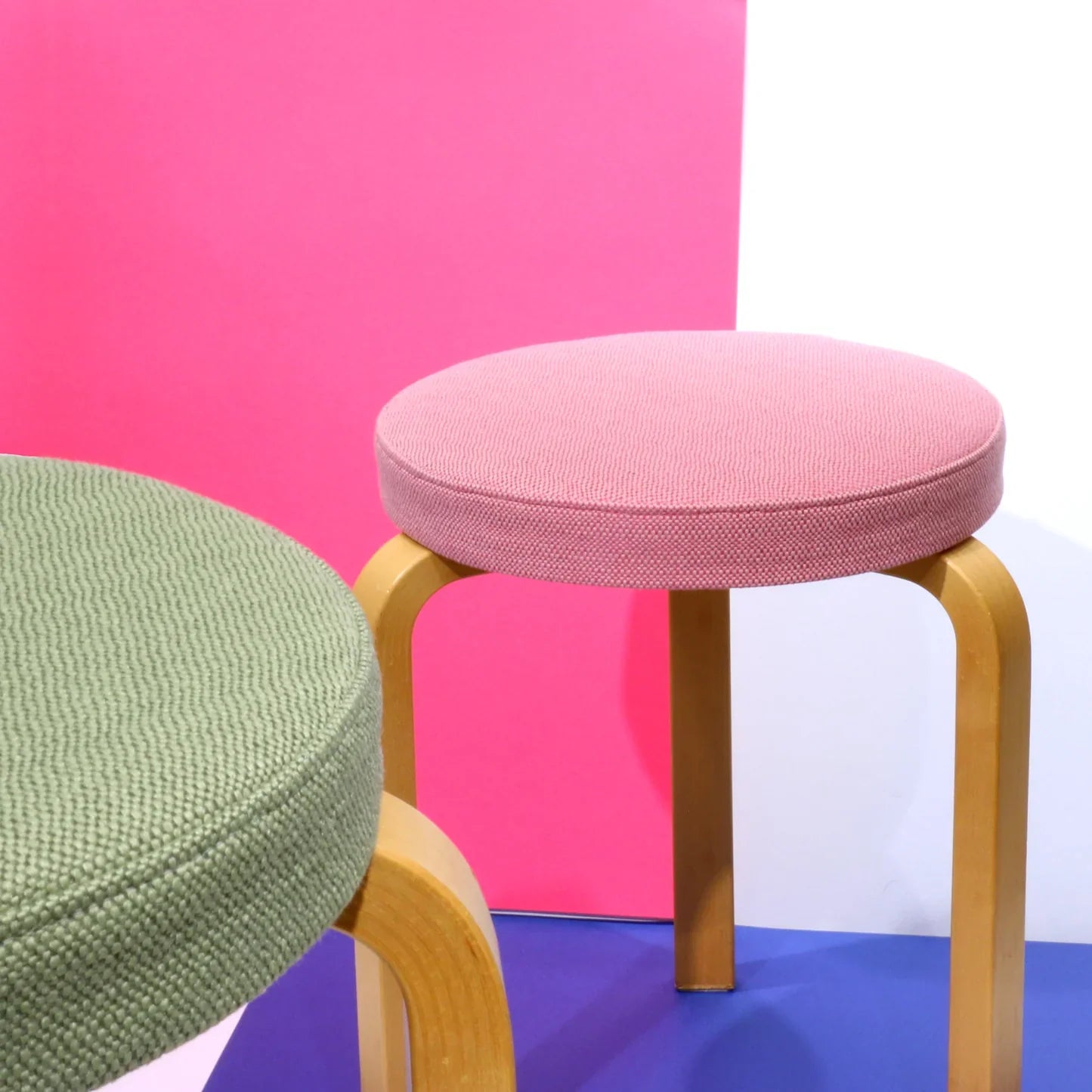
I don’t remember exactly where I first saw the Stool 60.
That’s probably the most honest way to begin this story.
Because this object doesn’t arrive with a moment. It doesn’t announce itself. It doesn’t create that cinematic pause where everything slows down and you notice.
It just… exists. Quietly.
And for a long time, that’s exactly what it was to me — background.

And maybe that’s why I never took it seriously.
There’s a certain bias we all have — or at least I do. If something is considered “good design,” I expect to feel it immediately. I expect some kind of reaction. A pause. A spark.
But this stool gave me nothing.
Just three legs.
A round seat.
Wood.
That was it.

I was looking at it again, probably out of boredom more than curiosity, and my eyes stopped at the legs. Not the whole object. Just that connection point where the leg meets the seat.
There was a curve.
Not a decorative curve. Not something expressive or exaggerated. Just a subtle, controlled bend — the kind you only notice if you’re already looking for something to notice.
And that’s where the story actually began for me.
I learned that it was designed by Alvar Aalto. That the legs weren’t just attached — they were bent using a technique that, at the time, was quietly revolutionary. Solid wood, shaped without breaking.
And suddenly, the stool felt different.
Not because it looked different.
But because I understood it differently.

There’s something strange that happens when you realize an object is smarter than it looks.
It’s like discovering that someone you thought was quiet is actually just… thinking more deeply than everyone else in the room.
The Stool 60 doesn’t perform intelligence. It hides it.
And once you see it, you can’t unsee it.
After that, I started noticing how it behaves.
Not how it looks — how it behaves.
You can stack it. And when you do, it’s almost satisfying in a way that’s hard to explain. The shapes align perfectly, like the object anticipated this exact action long before you did.
You can move it easily. It’s light, but it doesn’t feel fragile.
You can place it almost anywhere, and it never feels wrong. Not once.
I tried to imagine another piece of furniture that could do that — that could exist in so many roles without ever feeling misplaced.
A chair.
A table.
A surface.
A placeholder.
It adapts without changing.
At some point, I stopped thinking of it as “simple.”
Simple is what something looks like when you haven’t understood it yet.
What this is… is resolved.
Every decision already made. Every excess removed. Nothing left to explain.
I think what stayed with me the most is this: the Stool 60 doesn’t try to impress you upfront.
It doesn’t need that moment.
It plays a longer game.
You live around it. You ignore it. You underestimate it. And then, slowly, almost without realizing, you start respecting it.
Not because it demanded your attention —
but because it never needed to.
And maybe that’s the part that feels the most honest.
In a world where everything is trying so hard to be seen, to stand out, to be remembered instantly — this object does the opposite.
It stays quiet.
And somehow, that’s exactly why it stays.



Share:
Wiggle Chair: The Day I Realized Cardboard Could Be Luxury
A Quiet Object That Changed My Space