

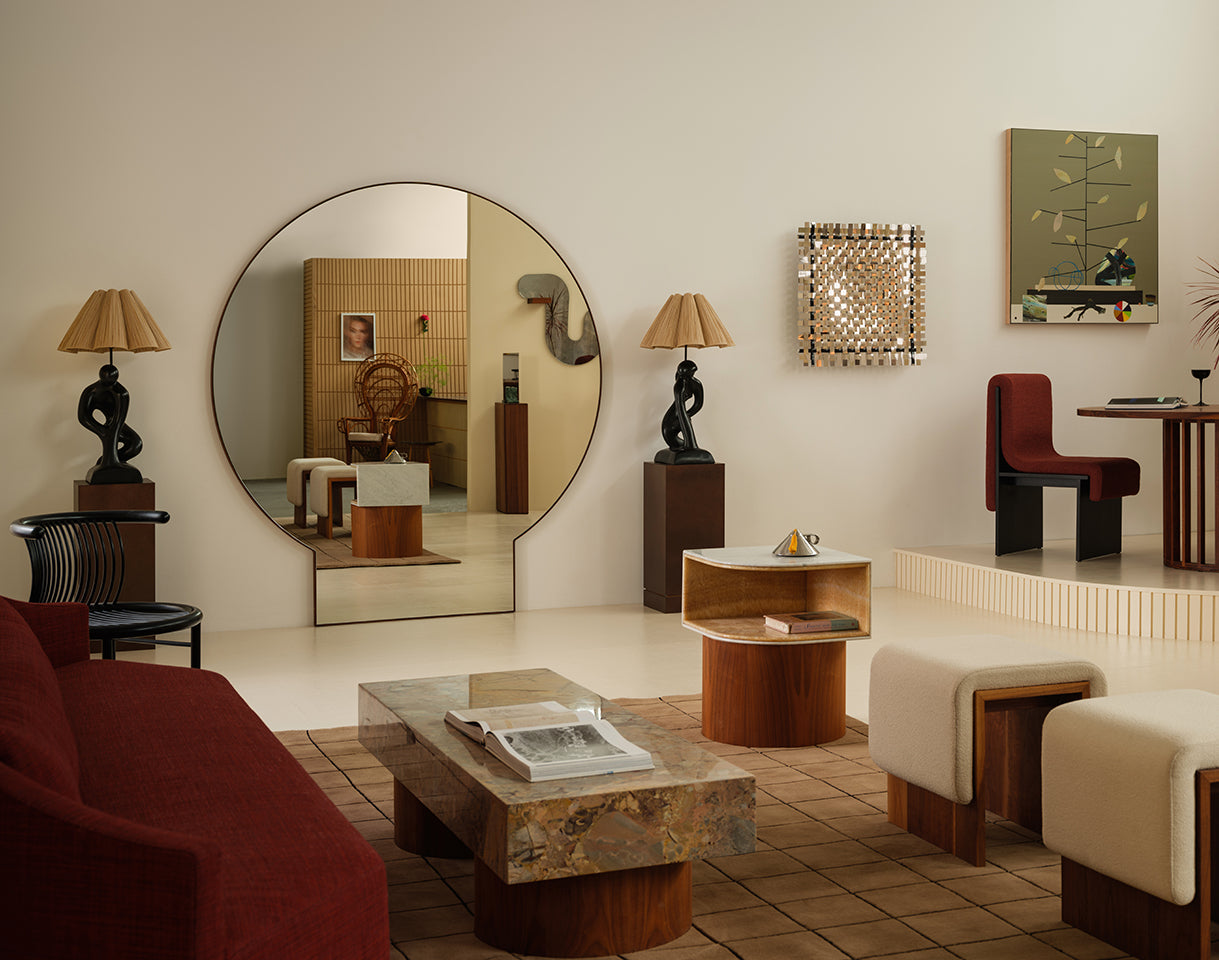
I remember the first time I noticed my reflection in the Bower Studios Full Circle Mirror—not in the usual, distracted way, but almost by accident. It was late afternoon, the kind of quiet hour when the light turns soft and forgiving. The mirror didn’t just show me; it held the room together somehow, like a pause in the middle of everything.
I hadn’t planned to buy it. I came across Bower Studios while browsing late at night, half-looking, half-drifting. Most mirrors blur together after a while—rectangular, predictable, obedient. This one felt different even through the screen. A perfect circle, yes, but interrupted in a way that made it feel almost human. Not flawless. Not trying to be.

When it finally arrived, the first thing I noticed was its weight. Not overwhelming, but present. The kind of weight that reminds you something is meant to stay. I ran my fingers along the edges before hanging it, tracing the subtle transition between glass and frame. There’s a quiet precision to it, but it doesn’t feel cold. It feels considered.
I placed it in a corner of my apartment that never quite worked before. Too empty for furniture, too visible to ignore. And suddenly, the space shifted. Not dramatically, not in a way that screams for attention—but enough. Enough to make me look twice when walking past.
Living with it became a kind of slow discovery.
In the mornings, it catches the light differently than any mirror I’ve owned. Not brighter—just… more intentional. The reflection feels framed in a way that draws you in without overwhelming you. I found myself standing in front of it longer than necessary, not out of vanity, but curiosity. The slight asymmetry creates a kind of tension, like something unresolved but beautiful.
And then there are the evenings. Artificial light softens its presence, and the mirror becomes less about reflection and more about atmosphere. It almost disappears into the room while still anchoring it. That balance is hard to explain, but once you feel it, you notice when it’s missing elsewhere.
From a design perspective, it’s deceptively simple.

The circular form isn’t new, of course. But what Bower Studios does here is interrupt the expectation just enough. The break in symmetry—subtle, almost hesitant—adds character without turning it into a statement piece that demands constant attention.
The materials feel honest. The glass is clear without being overly polished, if that makes sense. Some mirrors feel sterile, like they erase texture. This one keeps a sense of depth. The frame—minimal, but not forgettable—doesn’t compete with the reflection. It supports it.
Compared to other designer mirrors I’ve seen, many tend to lean too far in one direction. Either they become sculptural objects that sacrifice usability, or they remain purely functional and forgettable. This sits somewhere in between. It doesn’t try too hard to impress, which is exactly why it does.
But it’s not perfect.
There are moments when I wish it were just slightly larger. Not because it fails in scale, but because it invites more presence. You almost want to step into it, and the size reminds you that you can’t. It creates a kind of gentle frustration.
And the asymmetry, while beautiful, isn’t for everyone. I’ve had friends glance at it and tilt their heads, unsure if something is “off.” It’s one of those designs that asks for a bit of patience. You don’t immediately understand it—you grow into it.
I also noticed that it changes depending on what surrounds it. In a minimal space, it feels like a quiet centerpiece. In a busier room, it can get slightly lost. It doesn’t fight for attention, which is both its strength and its limitation.
But maybe that’s why I’ve grown attached to it.
It doesn’t try to define the room. It listens to it.
There’s something about that restraint that feels rare. We’re used to objects demanding attention, trying to prove their worth immediately. This mirror doesn’t do that. It reveals itself slowly, over days, then weeks. You start to notice how it holds light, how it frames movement, how it quietly alters your perception of space.
At some point, it stopped being just a mirror.

It became part of how I experience the apartment. A kind of visual rhythm. I catch glimpses of myself, yes—but also of everything else. The shifting daylight, the way shadows stretch across the floor, the small details I would otherwise ignore.
It made me more aware, which is not something I expected from an object like this.
If I had to describe what it changed, I’d say it softened the space. Not in a decorative way, but in a more subtle, emotional sense. It introduced a kind of calm that doesn’t feel staged.
Who is this for?
Not someone looking for a quick upgrade or a purely functional piece. It’s for people who notice how things feel over time. People who don’t mind a bit of ambiguity in design. Who understand that not everything needs to be immediately obvious to be meaningful.
Would I recommend it?
Yes but carefully.
Because this isn’t a mirror you “get” right away. It’s one you live with. And if you give it that time, it gives something back. Not loudly, not dramatically—but in small, quiet ways that stay with you longer than you expect.


Share:
The Stool I Almost Walked Past
Personal Story of the De Sede DS-1025 Terrazza Sofa