

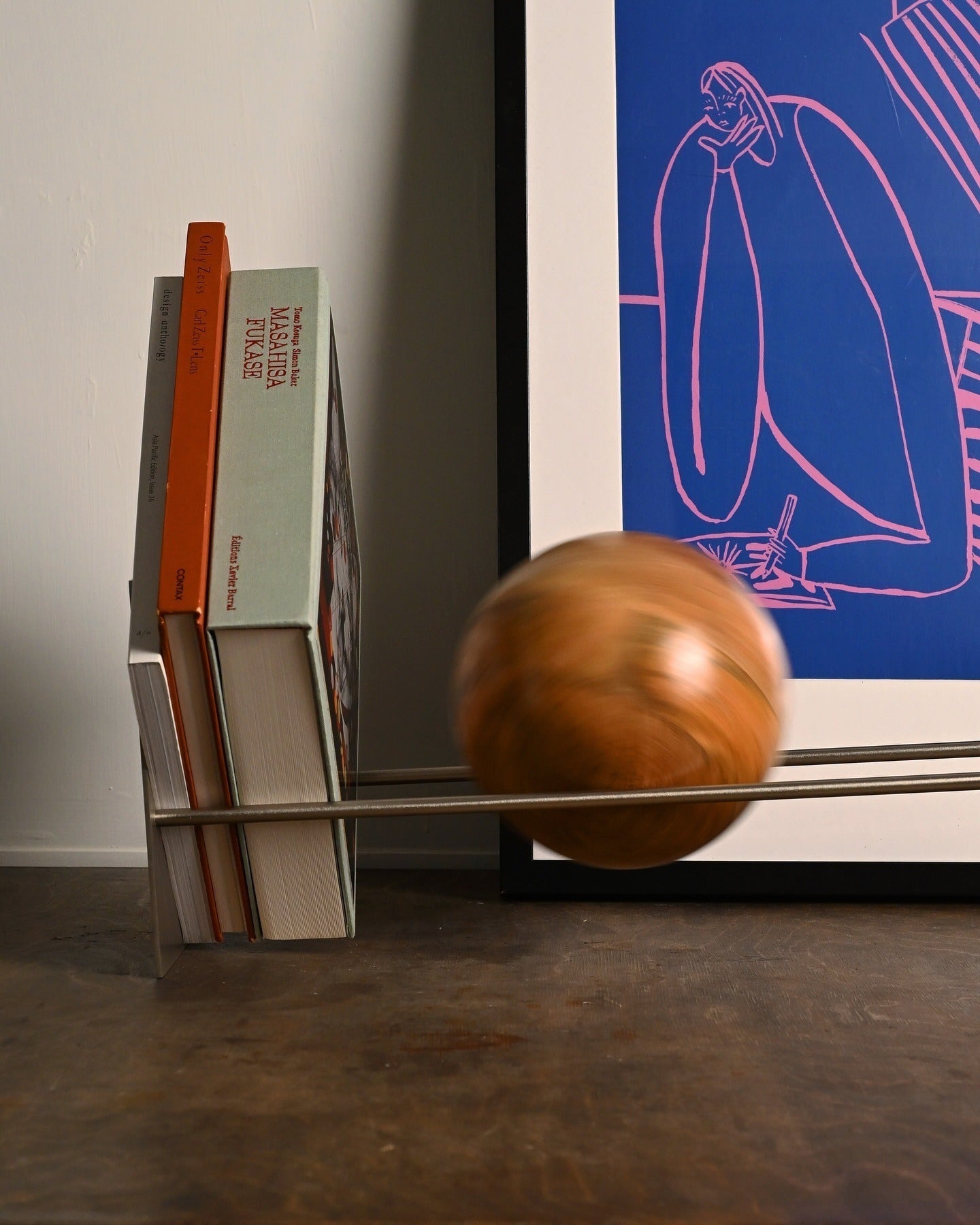
Most bookends are the most boring object on your shelf. This one is engineered to be the reason people ask "where did you get that?"
Here's an uncomfortable truth about the bookend aisle: 90% of what's sold under that name is a slab of weighted metal or resin, dressed up in a "decorative" finish, whose entire design brief was "be heavy enough to not fall over." Function first, appearance as an afterthought. That's why most bookshelves look like a library and not like a room someone actually designed.
The Geometric Acrylic & Stainless Steel Book Holder flips that brief. It doesn't hide its function behind a shape — the sphere, the acrylic panel, and the bent steel arm are the function, engineered so precisely that the stability comes from geometry and balance, not from bulk. It's the rare bookend that would still be worth having on a shelf with no books on it at all.

What This Bookend Actually Is
Strip away the styling language and here's the mechanical reality: a single length of polished stainless steel is bent into an L-shaped base, wide enough to sit flat and stable under the weight of a full row of hardcovers. At the raised end, a solid acrylic sphere — available in red, blue, or clear — rotates freely around the steel rod, acting as the load-bearing stop that keeps your books from sliding off the end. A tinted acrylic panel sits just behind the sphere, adding a second visual plane and a second point of contact for taller or heavier volumes.
The result reads like a single continuous gesture — ball, panel, rod — rather than three parts bolted together. That's a distinctly Bauhaus habit of mind: form emerges from structural necessity, not decoration applied on top of it.

Why the Sphere Isn't Just Decoration
A flat-faced bookend has one job: hold books upright with friction and weight. A sphere does that job differently — it concentrates contact into a single point, which means it can hold a stack upright with far less mass than a slab design needs. That's why this bookend feels almost weightless in the hand compared to traditional cast-iron or marble bookends, yet performs the same holding function once books are leaning against it.
It also solves a problem flat bookends create: sharp right angles that look institutional. A sphere against a stack of book spines creates contrast — soft against rigid, round against straight — which is the visual trick that makes this piece read as a design object first and organizational hardware second.

How It Compares to Traditional Bookends
| Feature | Geometric Sphere Bookend | Weighted Metal Bookend | Marble / Stone Bookend |
|---|---|---|---|
| Holding mechanism | Point-contact sphere + panel | Flat-face friction + mass | Mass only |
| Visual footprint | Sculptural, low-profile | Bulky, industrial | Heavy, formal |
| Works displayed alone (no books) | Yes — standalone object | No | Rarely |
| Surface risk | None — smooth steel/acrylic | Can scratch shelves | Heavy, can chip shelf edges |
| Best paired with | Modern, Bauhaus, minimalist interiors | Office, industrial spaces | Traditional, formal interiors |
Where It Actually Works in a Room
Because the base sits low and flat, this bookend does something most bookends can't: it works horizontally across a shelf, not just vertically stacked against a wall. A few placements worth trying:
- Console or credenza: lean a small stack of art books or magazines against the sphere, let the steel arm run along the surface — the piece becomes part of the tablescape, not hidden behind the books.
- Floating shelves: the low-profile base means it won't visually overwhelm a narrow shelf the way a tall bookend does.
- Desk setup: holds reference books or notebooks upright within reach, doubling as a sculptural accent next to a lamp or plant.
- Record and vinyl storage: the same point-contact principle that holds books upright works for vinyl sleeves, with the acrylic panel preventing lean-through.

Materials and Care
The frame is solid stainless steel with a mirror-polish finish, which resists tarnishing and won't need re-plating the way chrome-plated bookends eventually do. The sphere and panel are cast acrylic — durable, UV-stable for indoor use, and easy to keep clear with a simple wipe-down. Avoid abrasive cleaners on the acrylic; a microfiber cloth and mild glass cleaner keep both the sphere and panel free of fingerprints and dust.

Frequently Asked Questions
Is one bookend enough, or do I need a pair?
One unit works well against a wall, a vertical divider, or the end of a shelf, where the opposite side of the book stack already has support. For a freestanding stack in the middle of open shelving, most customers use two — one on each end.
How much weight can it hold?
The stainless steel base is engineered to support a standard row of hardcover books — typically 8 to 12 average-sized titles — without shifting. For unusually heavy art books or oversized volumes, we recommend using two units positioned closer together for added support.
Will the acrylic yellow or scratch over time?
The cast acrylic used here is UV-stabilized for indoor environments, so yellowing under normal indoor light is minimal. To prevent surface scratching, avoid dry-wiping — use a slightly damp microfiber cloth instead.
Does the sphere rotate or is it fixed in place?
The sphere is designed to sit securely on the steel rod but can rotate slightly, which actually helps it self-adjust to the angle of the books leaning against it rather than creating a single stress point.
What color pairs best with a neutral shelf?
Red creates the strongest contrast against white, oak, or grey shelving and is the most photographed option for that reason. Clear is the safer choice if you want the geometry to stand out without adding a new color into the room.
A bookend is supposed to be furniture you stop noticing after the first week. This one is built so you don't stop noticing it — which is either exactly what your shelf has been missing, or a small daily reminder that most "organizational" objects settled for a lot less than they could have been.


Share:
Ceramic vs. Glass Table Lamps: Which Holds Value? | Vessel Object
How Many Things Should You Own? Free Object Capacity Calculator