


A Rebellion in Two Hemispheres
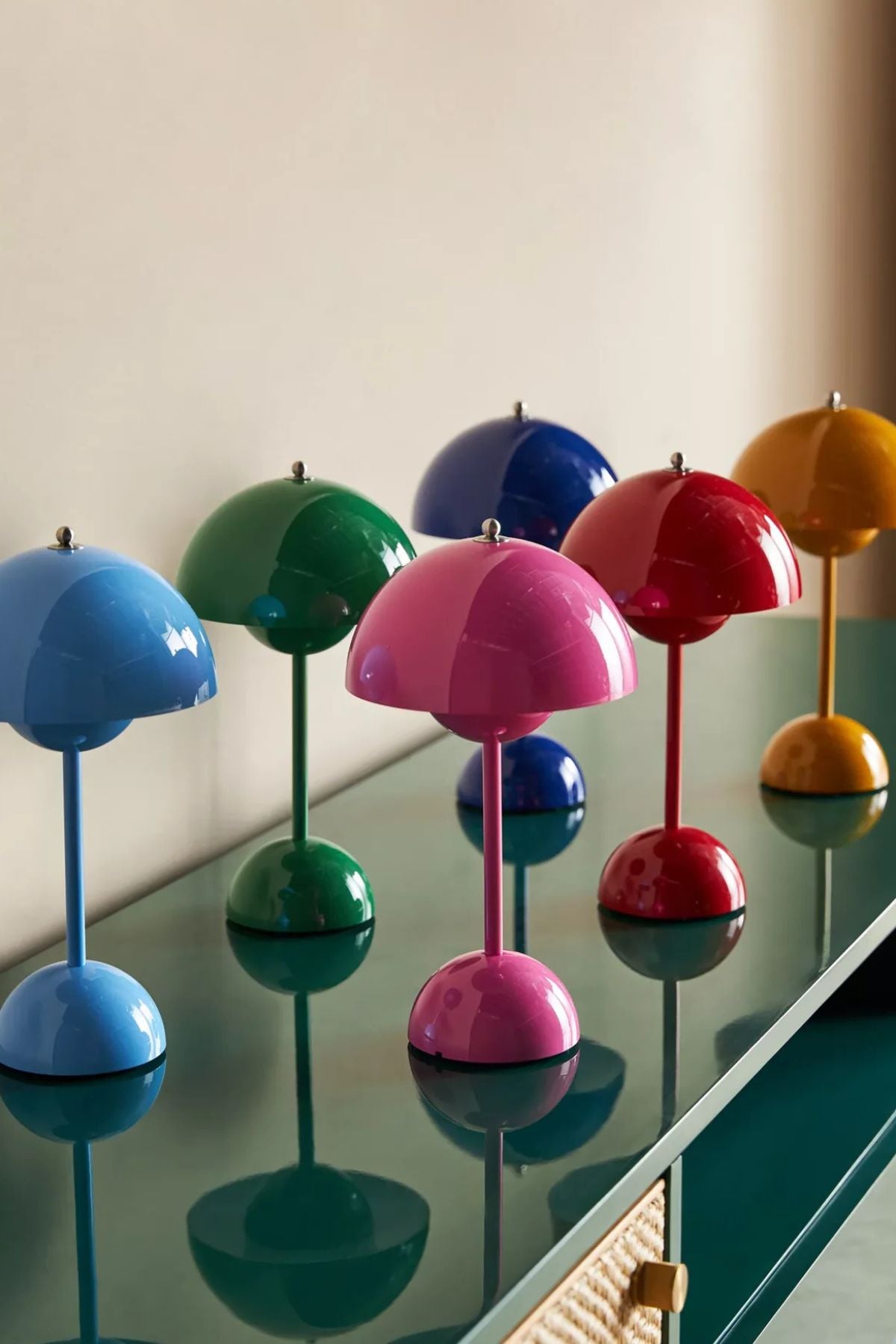
In 1968, Danish design meant one thing: warm wood, muted tones, and quiet restraint. Verner Panton wanted none of it. His Flowerpot lamp, released that year, is built from two matching dome-shaped shells — one sitting right-side up as the base, the other flipped upside down on top of it, meeting rim to rim like a flower pot balanced on its own reflection. Finished in a single saturated lacquer color, it looked like nothing else being designed in Copenhagen at the time, on purpose.

Photo: &Tradition — official product page
Two Identical Shapes, One New Object
The genius of the Flowerpot is how little it actually requires. There's no unique base, no separate shade, no hardware trying to look decorative — just two identical hemispherical shells, one of which happens to hide the light source and one of which happens to hold it up. Panton had spent the decade before designing plastic furniture that treated color as structure, not decoration, and the Flowerpot applies the exact same logic to a lamp: the shape is the whole design.
The Pop Answer to Scandinavian Minimalism
Panton's larger body of work — inflatable furniture, saturated color systems, the S-curved chair that bears his name — was a direct argument against the idea that Danish design had to whisper. The Flowerpot became the clearest, smallest example of that argument: a lamp so simple in construction that the color and the silhouette are the entire statement.
What the Flowerpot Teaches About Buying a Statement Lamp
- Color can do the work usually left to form. The Flowerpot's shape barely changes across versions — the lacquer finish is what gives each one its personality.
- Repetition of a single shape reads as intentional, not simple. Two identical domes feel considered in a way two different-looking parts wouldn't.
- A lamp doesn't need to be quiet to be timeless. More than 55 years on, the boldest version is still the most requested one.
If you're drawn to a dome-shaped lamp that leads with color, our Retro Mushroom Lamp follows the same instinct — a rounded glass dome available in the kind of saturated, unapologetic colors the Flowerpot made acceptable in the first place.
The Bottom Line
Verner Panton didn't need an elaborate mechanism to make a design statement — he needed two identical domes and the confidence to lacquer them orange. That confidence is still the whole reason the Flowerpot works.



Share:
The Bialetti Moka Express: A Coffee Pot Modeled on a Washing Machine
The Candle Holder That Taught Me About Shadow