

A Lamp That Disappears When You Don't Need It
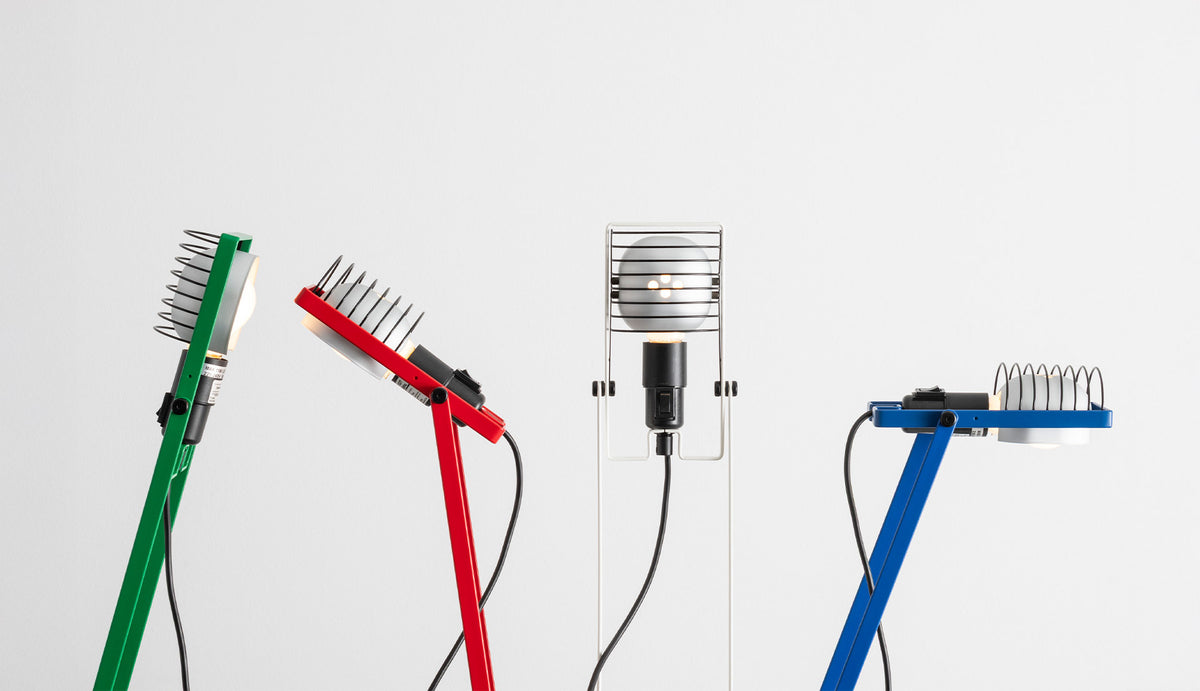
Some lamps are objects you notice on a desk. The Sintesi, designed by Ernesto Gismondi for Artemide in 1975, is a lamp you almost forget is there — right up until you try to pack it away, and realize it folds completely flat, like a piece of origami rather than a fixture with a socket and a wire.
Fifty years after its debut, Artemide has brought the Sintesi back in its four original 1975 colors — white, blue, green, and red — and in 2026 it picked up a Wallpaper* Design Award, recognized by the jury for "formal balance, mechanical intelligence and quality of light." For a lamp designed the same year as the first Apple II was still a year away, that's a strange kind of relevance to still be earning.

Photo: Artemide — official product journal
The Radical Idea: A Lamp That Folds Like Paper
Before the Sintesi, task lamps followed a predictable logic: a heavy base, a rigid arm, a shade, a socket — four separate systems bolted into one object that, once assembled, stayed exactly the shape it was built in.
Gismondi's idea broke that logic completely. The Sintesi is built around a single bent-metal Y-shaped support that acts as base, spine, and hinge all at once. The head — socket, reflector, and grid — pivots on that support, and the whole lamp collapses flat enough to slide into an envelope-thin box.
That single mechanical decision does two things most lamps don't: it makes the lamp genuinely portable, and it means the entire object reads as one continuous idea rather than a kit of parts.
Why a 1975 Design Still Reads as Contemporary
Most of what makes a 50-year-old object feel dated is visible complexity — screws, brackets, mechanisms you can see working. The Sintesi has almost none of that.
- No visible fasteners on the main joint
- A single continuous metal gesture from base to head
- A silhouette that reads the same folded flat or standing at full height
It's the same reason a well-made pocketknife or a good pair of scissors doesn't look old-fashioned: when the mechanism is the form, there's nothing left to date.
Color as the Whole Argument
The 2026 reissue leans hard into the original 1975 palette, and the choice is deliberate. Because the Sintesi's form is already reduced to a single gesture, color becomes the primary way the lamp expresses personality.
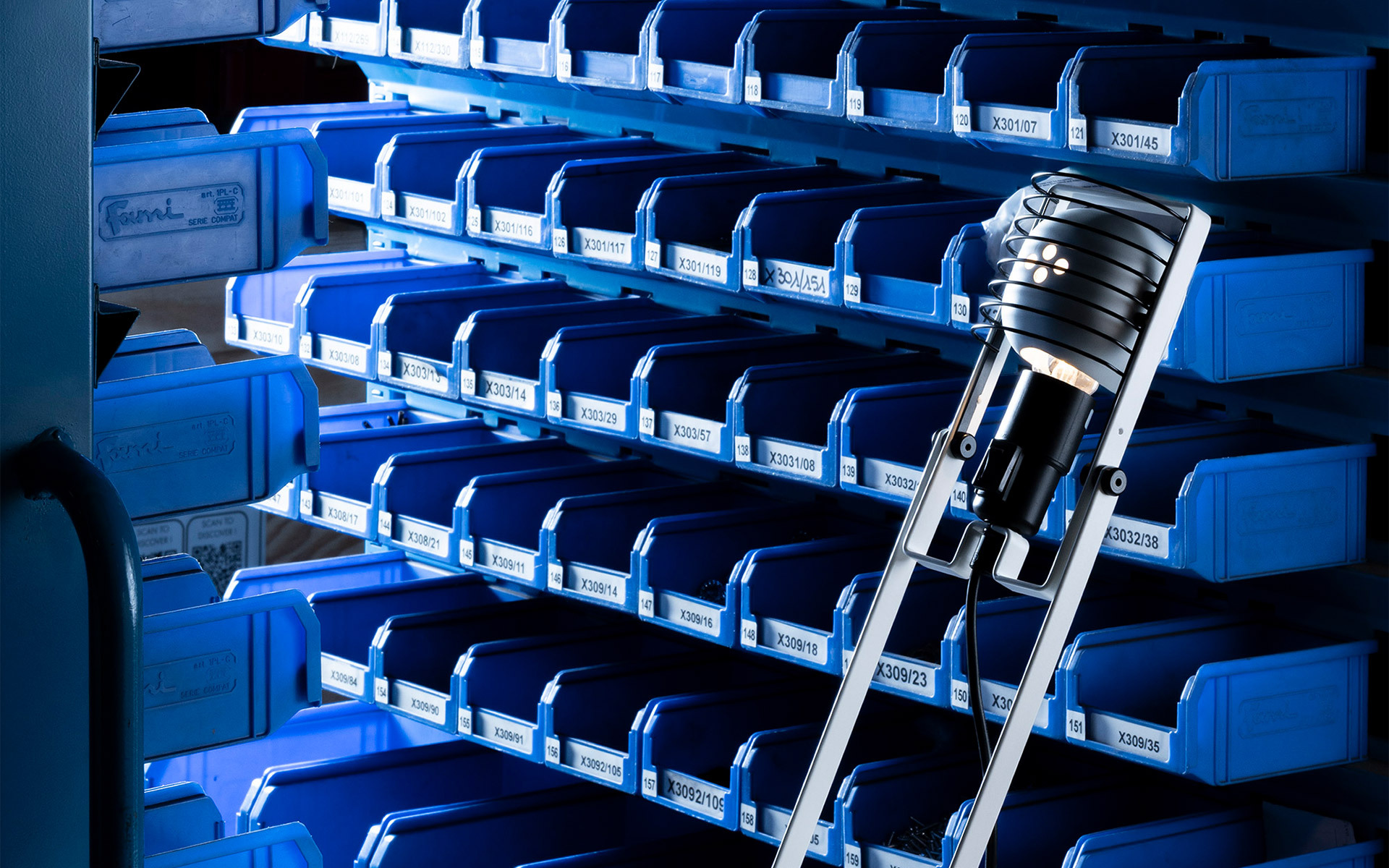
Photo: Artemide — official product journal
White reads as clinical and architectural. Red turns the same lamp into a graphic accent. Blue and green sit somewhere in between — confident without shouting. It's a strategy that shows up again and again in design objects that last: reduce the form to almost nothing, then let a bold, well-chosen color carry the identity.
What the Sintesi Teaches About Buying Lighting That Lasts
You don't need an Artemide budget to apply the lesson. When we're choosing which lighting designs to develop, we look for the same three things the Sintesi gets right:
- One mechanism, not five parts — fewer joints means fewer things to eventually wobble or break.
- A form that holds up with the light off — if it only looks good illuminated, it's a bulb with a stand, not a design object.
- Color doing real work — not decoration, but the main way the piece signals personality in a room.
If that kind of restraint is what you're after, our own BULB light follows the same brief: one monolithic iron form, no visible hardware, available in bold colorways for wall or tabletop — a sculptural light first, a fixture second.
The Bottom Line
The Sintesi isn't impressive because it's 50 years old. It's impressive because, fifty years on, almost nothing else on the market folds this flat, says this much with one shape, or still looks like it was designed for a room that hasn't been built yet.
That's the actual definition of a design icon: not that it survived its decade, but that it never needed updating to leave it.


Share:
How Many Things Should You Own? Free Object Capacity Calculator
Stool 60 at 90+: Why Alvar Aalto's Three-Legged Stool Never Needed a Redesign