

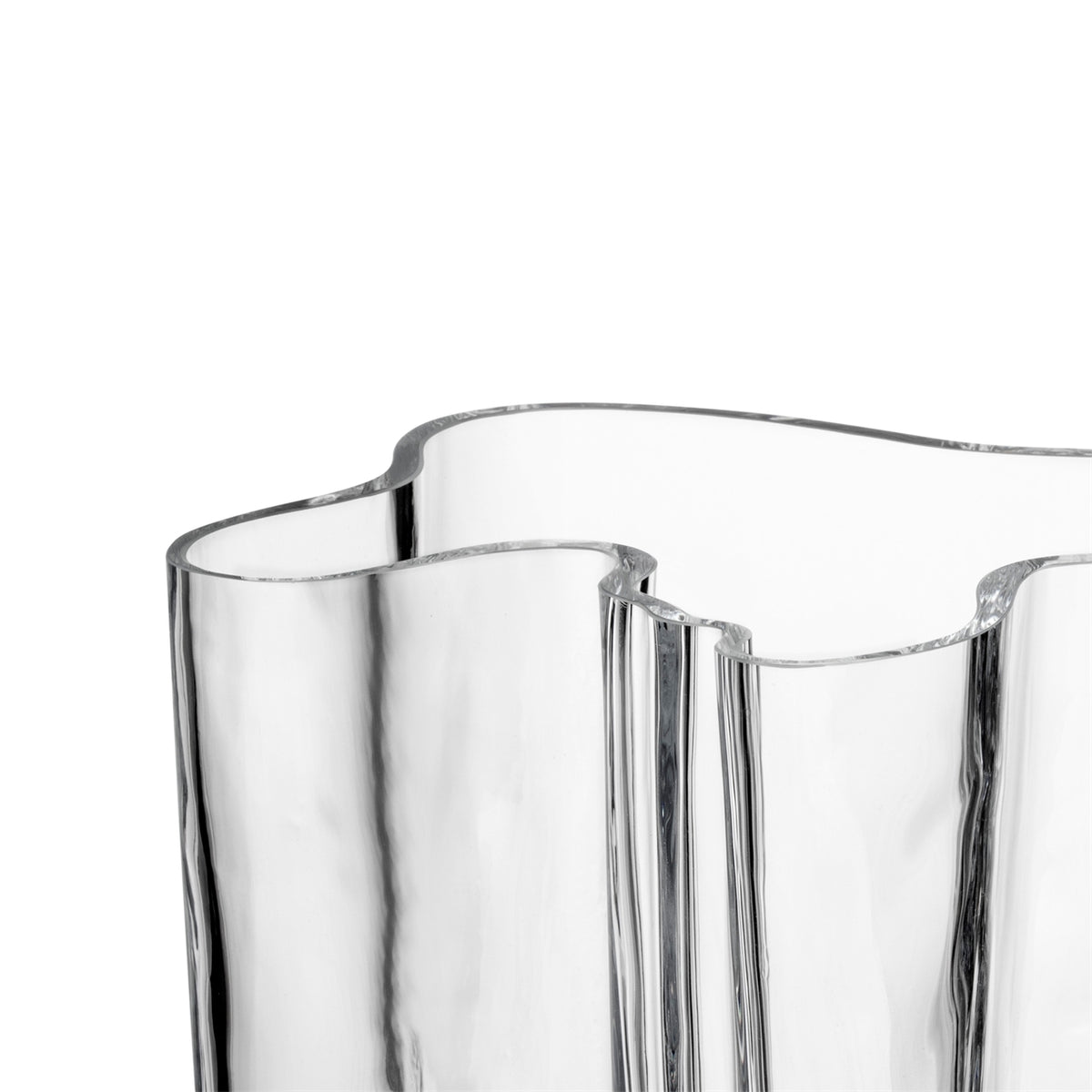
A Vase With No Correct Way to Set It Down
Pick up almost any vase and there's an obvious front, an obvious back, and an obvious way it's supposed to sit on a shelf. The Aalto vase, designed in 1936 by architects Alvar and Aino Aalto for the Karhula-Iittala glassworks, refuses that logic entirely. Its rim is an unbroken, freehand curve with no straight edges and no fixed orientation — turn it, and it reads as a completely different object.
That wasn't an accident of glassblowing. It was the entire design brief.

Photo: Iittala — official product page
Shaped Like Water, Not Like a Container
The Aaltos' inspiration is famously tied to the Finnish landscape — the irregular, meandering shorelines of the country's tens of thousands of lakes, traced without a single straight edge. Rather than design a vessel and decorate it afterward, they designed the outline first, the way a mapmaker traces a coastline, and let the glass follow it.
The result behaves less like a container with sides and more like a captured puddle of glass — which is exactly why it photographs differently from every angle and never reads as a symmetrical, mass-produced object, even though it's been in continuous production for close to ninety years.
Why Hand-Blown Still Matters Here
Every Aalto vase is still mouth-blown, one at a time, into a wooden mold that itself wears down and is eventually replaced — meaning no two production runs, and arguably no two vases, are perfectly identical. For a shape this irregular, that's not a limitation of the process; it's the reason the process still exists. A machine-perfect version of an intentionally imperfect curve would defeat the entire idea.
What an Asymmetrical Object Does for a Room
Most home decor is built on symmetry and repetition — matching lamps, aligned frames, centered arrangements. A single freeform object breaks that pattern in a useful way:
- It reads as a focal point without needing a pair. Symmetrical objects want company; asymmetrical ones can stand alone.
- It changes depending on where you're standing. A shelf styled with an irregular silhouette looks different from every seat in the room.
- It softens a space full of straight furniture lines. One organic shape does more visual work than several would.
If that kind of sculptural, no-two-alike silhouette is what you're after, our own Retro Form Ceramic Vase follows the same instinct in glazed ceramic — bold, asymmetrical proportions designed to read as a standalone object first, a vase second.
The Bottom Line
The Aalto vase has survived nearly a century of design trends by refusing to have a "correct" side at all. In a category built almost entirely on symmetry, that's still the most quietly radical decision a vase can make — and it's a large part of why this one is still hand-blown, one at a time, instead of stamped out by the thousand.


Share:
The Stelton EM77: A Thermos Redesigned Because of a Sailboat
Alessi's 9091 Kettle Doesn't Whistle. It Sings a Chord.