

The Everyday Object Nobody Thought to Question
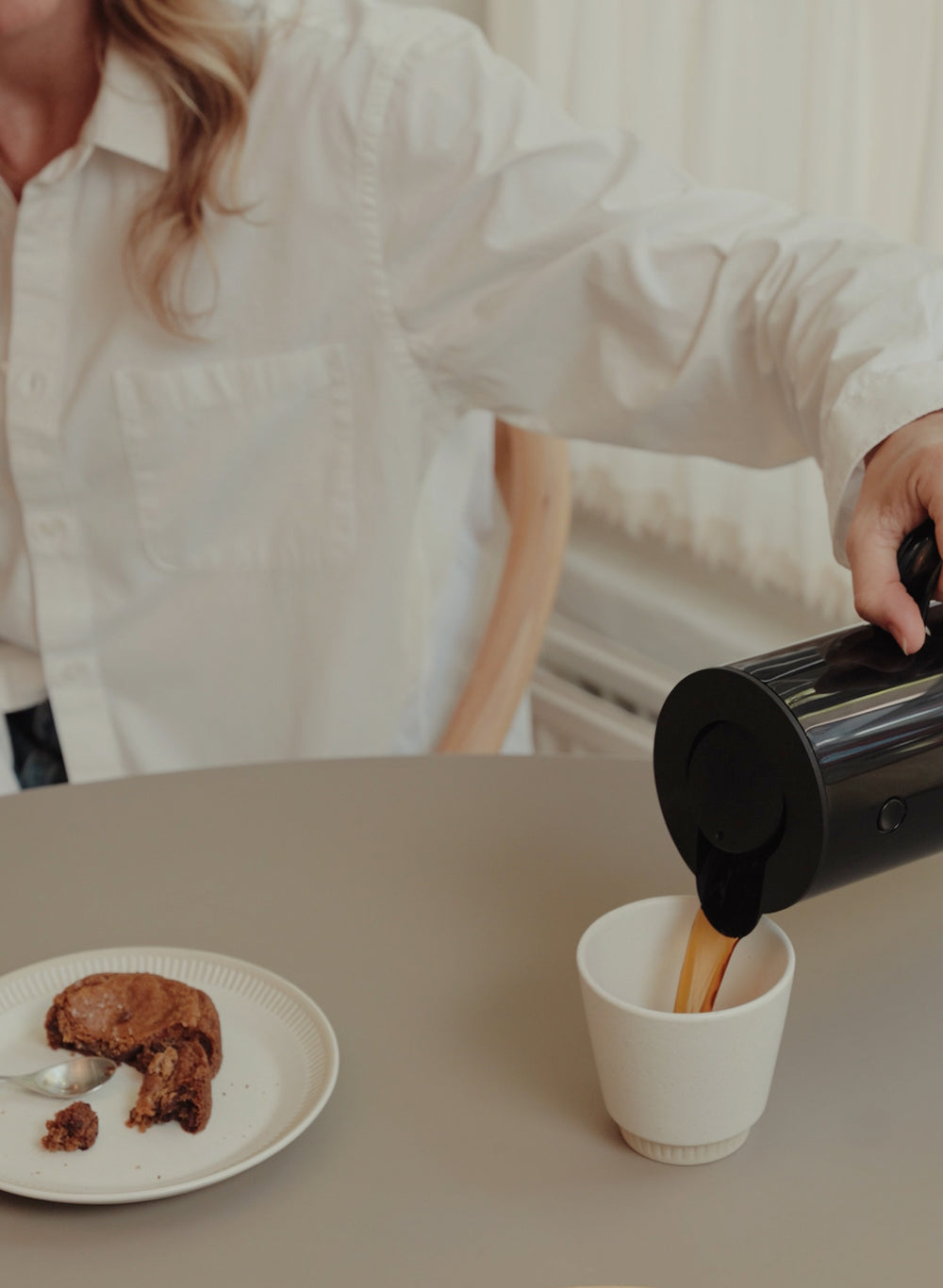
By the mid-1970s, the vacuum jug was a solved problem, or so everyone assumed. You unscrewed a stopper, poured, then had to find somewhere to set the wet stopper down before you could put the lid back on. Every thermos worked this way. Nobody was asking for a redesign.
Danish silversmith Erik Magnussen got the assignment anyway: Stelton wanted a companion piece to Arne Jacobsen's cylindrical Cylinda-Line, something equally at home on a design-conscious table. Magnussen decided the stopper itself was the actual design problem worth solving — he just hadn't figured out how yet.

Photo: Stelton — official product page
The Answer Was on a Sailboat, Not a Drawing Board
The breakthrough, as the story goes, came while Magnussen was out sailing and noticed a ship's instrument mounted on a gimbal — a pivoting cradle that keeps a compass or clock level no matter how the boat rolls. He realized the same principle could let a stopper flip open under its own weight and snap shut again, with no separate piece to misplace and no screwing or unscrewing required.
That "rocker stopper" became the EM77's entire identity: tip the jug, the stopper opens itself; set it upright, it seals itself. It's the rare kitchen mechanism that feels less like engineering and more like a small piece of choreography.
Why a Cylinder Became a Design Icon
The EM77 pairs that mechanism with a body about as reduced as a vacuum jug can get: a plain steel cylinder around a glass insulating insert, with almost nothing to distract from the stopper doing its trick. That restraint is exactly why the jug won the Danish Society of Industrial Design's ID Prize the year it launched, and why it's been reissued in more than 100 colors and finishes since — the form is neutral enough to carry practically any surface treatment without looking dated.
What the EM77 Teaches About Buying Everyday Objects
Most of what's in a kitchen cabinet was designed once and never questioned again. The EM77 is a reminder that the objects worth keeping for decades are usually the ones where someone bothered to ask why a small daily annoyance had to exist at all.
- Look for a mechanism, not just a shape. A well-solved daily friction point ages better than a trendy silhouette.
- Reduced forms outlast decorated ones. A shape with nothing to date it can be re-colored forever; an ornamented one is stuck in its decade.
- The best fix is often borrowed from somewhere else entirely. Magnussen's solution came from sailing instruments, not other thermoses.
If you like drinkware that treats insulation as a design problem rather than an afterthought, our Stainless Steel Thermal Cup takes the same double-wall, no-frills approach — a handleless, all-metal form built to keep drinks at temperature for hours without adding anything unnecessary to the shape.
The Bottom Line
Nobody asked Erik Magnussen to reinvent the thermos stopper. He did it anyway, because he noticed a small daily annoyance that everyone else had simply accepted. Almost fifty years later, that's still the whole argument for good design: not more features, just fewer unnecessary ones.


Share:
The Noguchi Table: Born From a Grudge, Now the Most Copied Table in Design
The Aalto Vase: A Piece of Glass Shaped Like a Finnish Lake