

A Table Designed Out of Spite
Most design icons have an origin story about solving a problem. The Noguchi table has one about a grudge.
In the late 1930s, sculptor Isamu Noguchi designed a small glass-topped table for furniture designer T.H. Robsjohn-Gibbings. Noguchi heard nothing further about it — until, while interned in an Arizona relocation camp during World War II, he saw a version of his own model published under Robsjohn-Gibbings' name. When Noguchi objected after his release, the designer's response was dismissive: anyone could make a three-legged table.
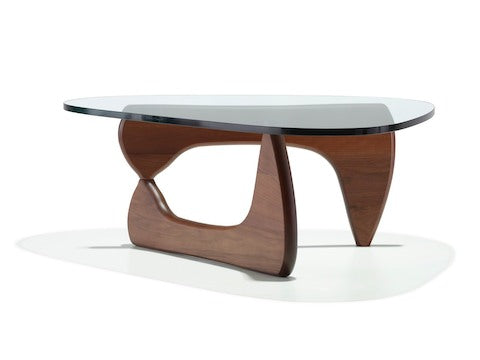
Noguchi's reply was to design a better one, entirely his own. That "variant" table went on to illustrate a Herman Miller article by legendary designer George Nelson called "How to Make a Table" — and that illustration became the coffee table that still bears Noguchi's name.
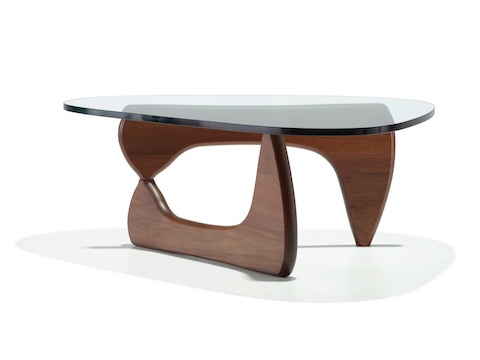
Photo: Herman Miller — official design story
A Sculptor's Table, Not a Furniture Designer's Table
Noguchi wasn't a furniture designer by trade — he was a sculptor who happened to make a table. That distinction shows up in every part of the design. The base is two identical, freeform wood pieces that interlock without hardware, balanced so precisely that the heavy plate-glass top rests on just three points of contact.
Most coffee tables are built from the top down: pick a surface size, then engineer legs to hold it up. The Noguchi table was built from the base up, as a piece of freestanding sculpture that happened to be useful as a table — which is exactly why it reads as art first and furniture second, even eighty years later.
Why It Became the Most Copied Table in Design
Walk into any furniture showroom today and you'll find dozens of glass-topped tables with sculptural wood or stone bases — nearly all of them working from the same idea the Noguchi table established: let the base be the art, and let the glass disappear.
Glass does two things a solid top can't. It lets the sculptural base remain fully visible from above, and it keeps a physically substantial object from ever feeling heavy in a room. That combination is the actual template every "sculptural coffee table" since has been chasing, whether or not the brand admits it.
What the Noguchi Table Teaches About Choosing a Coffee Table
You don't need a MillerKnoll budget to apply the same logic when furnishing a room. The questions worth asking are the same ones Noguchi's design answers:
- Does the base stand on its own as an object? If you'd be embarrassed to have it visible with nothing on top, it's not doing its job.
- Is the top doing the disappearing? A transparent or reflective surface lets a bold base read as sculpture instead of furniture.
- Is it balanced, not bolted? Furniture that relies on precise geometry rather than hardware tends to age as an object, not just a product.
Our own Mirror Cube Table works from the same brief in a more compact, contemporary register — a minimalist acrylic form whose mirrored surface does what Noguchi's glass did: let the geometry disappear into reflected light instead of sitting heavy in the room.
The Bottom Line
The Noguchi table exists because someone told Isamu Noguchi that anybody could make a three-legged table. He proved that almost nobody could make one this good — and design has spent eighty years agreeing with him.
That's the real lesson buried in the grudge: the best answer to "anyone could do this" is usually to just do it better.


Share:
Stool 60 at 90+: Why Alvar Aalto's Three-Legged Stool Never Needed a Redesign
The Stelton EM77: A Thermos Redesigned Because of a Sailboat